
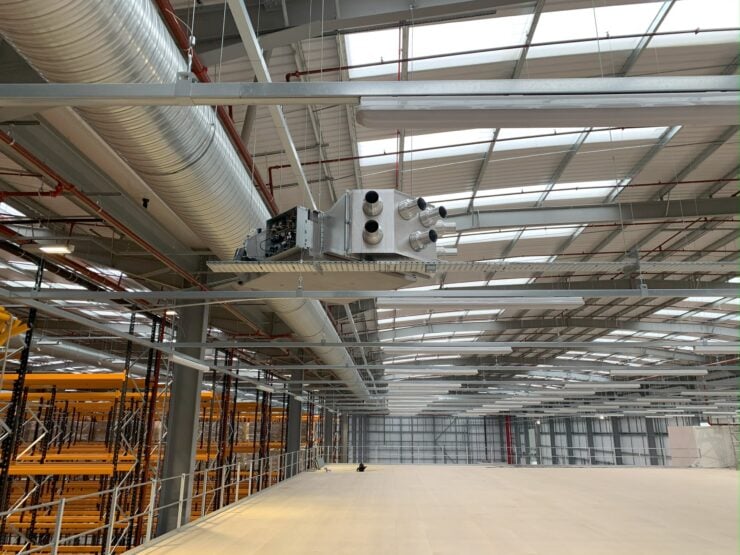
Air Conditioning and Ventilation Systems for Warehouses


Air Conditioning and Ventilation Systems for Warehouses

We’ve all seen those enormous warehouses dotted around the landscape, but most warehouses are much smaller and located in local areas.

Warehouses are designed to store products, equipment, and raw materials. However, all types of goods require specific storage conditions. So whether you’re storing food, chemicals, electronics, or packaging, choosing the right air conditioning and ventilation system is vital.

The right system will not only protect your goods, but it will also keep employees comfortable and ensure energy costs are kept as low as possible.

Here are some of the most common types of warehouse air conditioning and ventilation systems and applications.

Why Warehouse Climate Control Matters

A well-designed climate control system does more than regulate temperature. It helps:

  • Protect temperature-sensitive products from damage
  • Improve indoor air quality by removing dust particles, fumes, and moisture
  • Create a healthier working environment for employees
  • Reduce condensation and mould growth
  • Improve energy efficiency and lower energy bills
  • Meet legal health and safety standards in industrial environments.

Choosing the Right Warehouse Climate Control Solution

Installing the right type of air conditioning or ventilation system requires careful planning and skills. A qualified air conditioning engineer will assess the warehouse size, the ceiling height, the type of insulation, the occupancy levels, and the type of goods being stored.

This will identify the right type of climate control system required. The following are common solutions.


Split Air Conditioning Systems

A split air conditioning system consists of an indoor unit air conditioner that is connected to an outdoor condenser. These are typically installed in small offices, kitchen areas, and small warehouse spaces.

Split systems are cost-effective, quiet and energy efficient. They deliver cooling and heating to specific zones and can automatically turn off if area are unoccupied for set periods of time.

Multi-Split Air Conditioning Systems

A multi-split system allows multiple indoor units to be connected to one outdoor unit. They are ideal where different rooms require independent temperature control e.g.

  • Warehouses with several offices or zones
  • Meeting rooms
  • Kitchen and washroom areas

Advantages

Saves outdoor space

Offers individual room temperature settings

Lower installation costs than multiple separate systems

VRF and VRV Air Conditioning Systems

When it comes to larger commercial warehouses, Variable Refrigerant Flow (VRF) and Variable Refrigerant Volume (VRV) systems are more advanced solutions that are designed for big floor spaces.

These systems adjust the flow of refrigerant according to demand, providing highly efficient heating and cooling throughout multiple zones. They are best for:

  • Large warehouses
  • Distribution centres
  • Mixed-use industrial facilities
  • Retail warehouses
  • Buildings with mixed occupancy levels

Advantages

Excellent energy efficiency

Simultaneous heating and cooling in different areas

Flexible zoning

Lower operating costs over time.

Rooftop Packaged Units

Packaged rooftop units house a compressor, condenser, evaporator, and fan in one self-contained system that is mounted on the roof.

These systems deliver heating, cooling, and ventilation (HVAC) and are widely used in industrial and commercial warehouses because they save valuable floor space.

Packaged units are efficient, easy to maintain and ideal for large open-plan areas. They are best for:

  • Large warehouses with large floor areas
  • Manufacturing facilities
  • Logistics hubs

Industrial Ventilation Systems

Warehouses are notoriously dusty and can be poorly ventilated. Ventilation systems are therefore essential, even when cooling is not required. Their primary role is to remove stale air, dust, fumes, moisture, and airborne contaminants while introducing fresh outdoor air.

Common ventilation options include:

Mechanical Ventilation

Powered extraction and supply fans maintain continuous airflow throughout the building.

Natural Ventilation

Roof vents, wall louvres, and ridge ventilation allow fresh air to circulate using natural air movement.

Local Exhaust Ventilation

Designed to remove dust, fumes, smoke, or chemical vapours directly at the source before they spread throughout the warehouse.

Other considerations when choosing warehouse climate control

When installing warehouse air conditioning, it’s important also to consider:

  • Future business expansion
  • Ongoing service and maintenance requirements
  • Adequate equipment installation space

Every warehouse has unique environmental requirements – there is no one-size-fits-all solution. From simple split systems for office areas to sophisticated VRF installations and industrial ventilation systems for large facilities, choosing the right equipment can improve productivity, safeguard stock, and reduce operating costs.

By investing in the correct air conditioning and ventilation system, you can create a safer, healthier, and more efficient working environment while protecting valuable inventory 24 hours a day.

For more information about warehouse air conditioning and ventilation, please get in touch and arrange to chat with one of our engineers.


We're local, we're trusted and we're good! Please get in touch.

Book a FREE property survey | Request a FREE quotation | Book a system service

"*" indicates required fields

This field is for validation purposes and should be left unchanged.

Share this page


This entry was posted in Blog